
Hip Replacement Recovery: What to Expect Week by Week

Hip replacement recovery is a gradual process that begins immediately after surgery and continues for several months. Most people use a walker early in recovery, gradually improve strength and mobility, and return to many daily activities within 6 to 12 weeks. Full recovery may continue for up to a year as strength, endurance, balance, and confidence continue to improve.
This hip replacement recovery guide explains what many patients experience during the first week, first month, and first year after surgery, including walking progression, hip precautions, sleeping recommendations, driving timelines, and important recovery milestones.
What You'll Learn About Hip Replacement Recovery
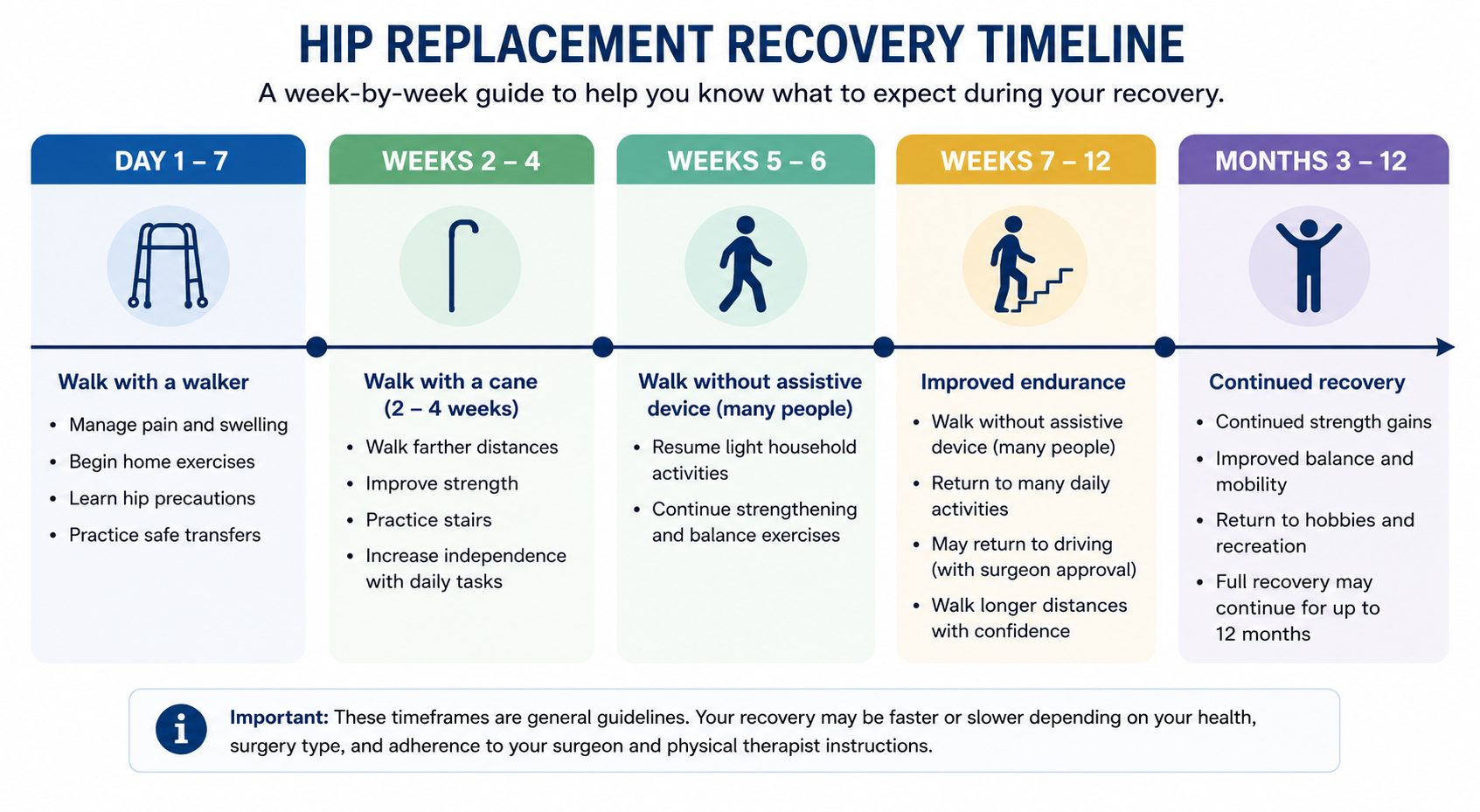
Hip Replacement Recovery Timeline
The timeline below gives a general overview of what many people experience after total hip replacement surgery. Your recovery may be faster or slower depending on your age, health, surgery type, pain level, strength, balance, home support, and surgeon’s instructions.
Hip Replacement Recovery Milestones at a Glance
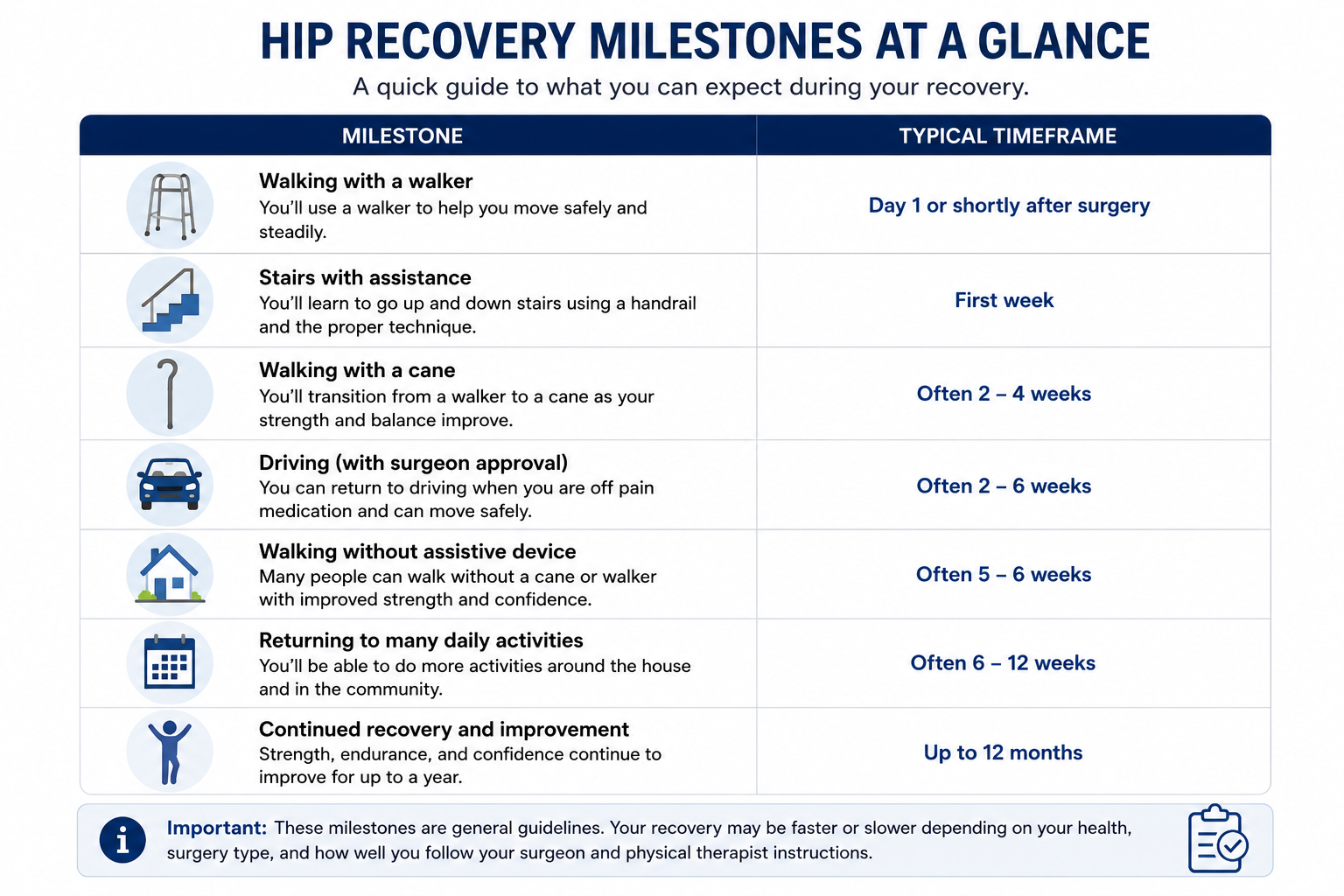
| Milestone | Typical Timeframe |
|---|---|
| Walking with a walker | Day 1 or shortly after surgery |
| Climbing stairs with assistance | First week |
| Walking with a cane | Often 2–4 weeks |
| Driving, with surgeon approval | Often 2–6 weeks |
| Walking without an assistive device | Often 5–6 weeks or later |
| Returning to many daily activities | Often 6–12 weeks |
| Continued recovery and improvement | Up to 12 months |
Day 1–7 After Hip Replacement
The first week after hip replacement focuses on healing, pain control, swelling management, and safe movement. Many patients begin walking with a walker shortly after surgery.
Early walking helps improve circulation, reduce stiffness, and build confidence. You may also begin simple home exercises and practice transfers, stairs, and safe movement around the home.
Common Goals
- Walk short distances with a walker
- Manage pain and swelling
- Practice safe transfers
- Begin home exercises as instructed
- Learn your hip precautions
Safety Focus
The first week is not about rushing. It is about moving safely, protecting the new hip, following precautions, and preventing falls while your body begins healing.
Weeks 2–4 of Hip Replacement Recovery
During weeks 2 through 4, many people begin walking farther, building strength, and becoming more independent with daily activities.
Some people transition from a walker to a cane during this stage. This should happen only when walking is safe, controlled, and approved by your surgeon or physical therapist.
Weeks 5–6 of Hip Replacement Recovery
By weeks 5 and 6, many people are walking with improved strength and balance. Some may begin walking without an assistive device, while others may still benefit from a cane for safety.
Light household activities may become easier, and walking distances often improve. Continued strengthening and balance exercises are important during this stage.
Weeks 7–12 of Hip Replacement Recovery
During weeks 7 through 12, many people return to more daily activities and feel more confident moving around the home and community.
Endurance usually improves, walking may become smoother, and low-impact activity may be added when approved by the surgeon. Some patients may also return to driving during this stage if they meet safety requirements and have surgeon approval.
Months 3–12 After Hip Replacement
Hip replacement recovery can continue well beyond the first three months. Strength, endurance, balance, walking confidence, and mobility may continue to improve for up to a year.
Many people return to hobbies, community activities, and low-impact recreation during this longer recovery phase. Staying active and consistent with safe exercise can help support long-term success.
Hip Precautions After Hip Replacement
Hip precautions are movement restrictions used to help protect your new hip while the joint and surrounding tissues heal. Not every patient has the same precautions. Your restrictions depend on the surgical approach, surgeon preference, implant stability, and your individual medical history.
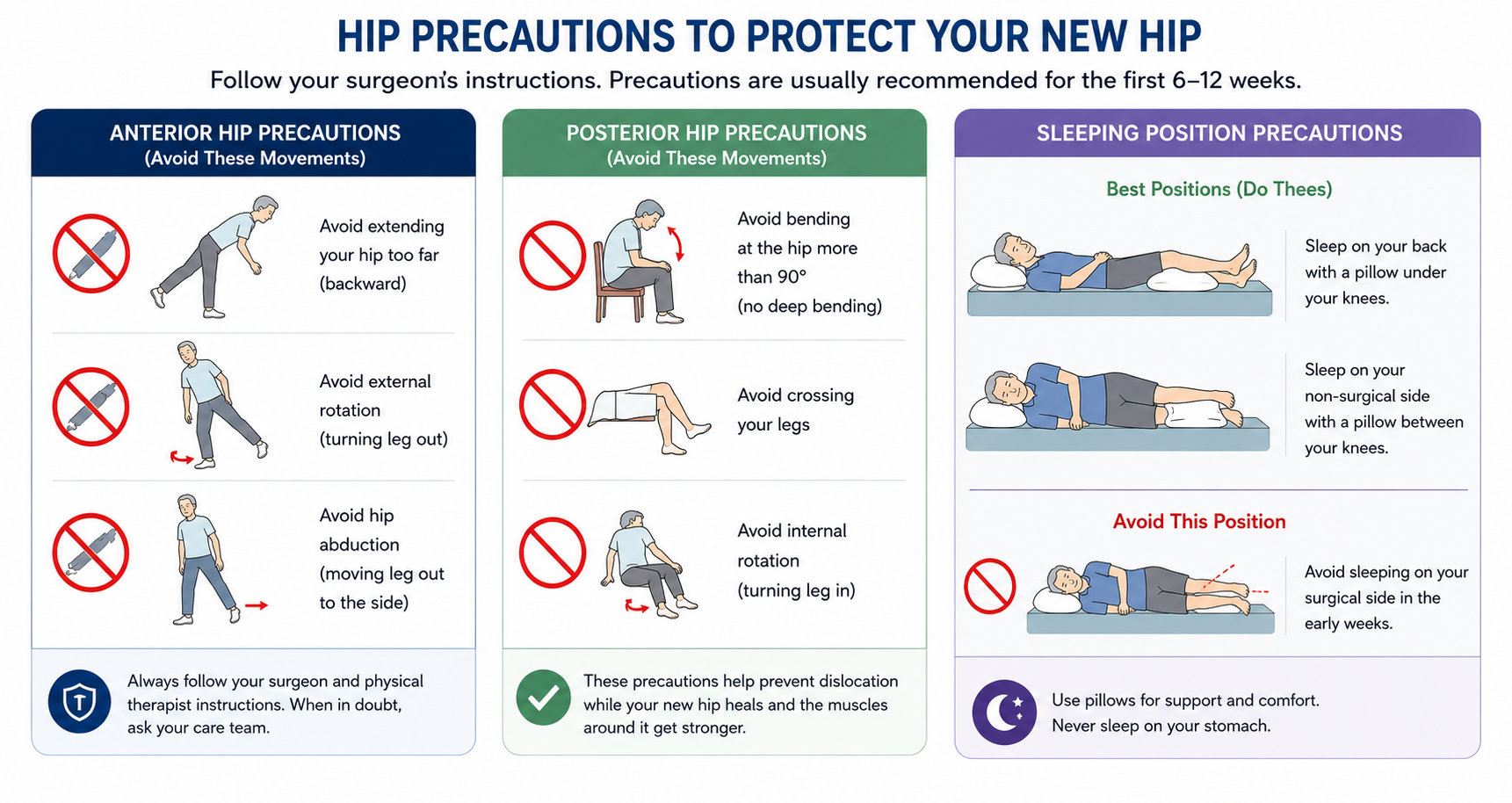
Anterior vs Posterior Hip Precautions
Hip precautions are often described based on the surgical approach. The two most common categories are anterior hip precautions and posterior hip precautions.
Anterior Hip Precautions
Anterior hip precautions often focus on avoiding positions that place the hip too far backward or rotated outward.
- Avoid excessive hip extension
- Avoid excessive external rotation
- Avoid moving the leg too far out to the side if instructed
- Follow surgeon-specific restrictions
Posterior Hip Precautions
Posterior hip precautions often focus on avoiding positions that place the hip in deep bending, twisting, or crossing.
- Avoid bending the hip more than 90 degrees
- Avoid crossing your legs
- Avoid turning the surgical leg inward
- Avoid twisting on the surgical leg
Sleeping After Hip Replacement Surgery
Sleeping after hip replacement can be uncomfortable at first. Pillows may help support your legs and keep your hip in a safer position.
Many patients are advised to sleep on their back or on the non-surgical side with a pillow between the knees. Sleeping on the surgical side may be restricted early in recovery or may simply be too uncomfortable.
How Long Will You Need a Walker or Cane?
Most people begin hip replacement recovery with a walker. Many transition to a cane as strength, balance, pain, and walking quality improve.
A common progression is walker, then cane, then independent walking. Many patients begin using a cane around weeks 2 to 4, but this varies from person to person.
Your physical therapist can help determine when it is safe to move from one device to the next.
When Can You Drive After Hip Replacement?
Driving after hip replacement depends on which hip was replaced, whether you are taking narcotic pain medication, your reaction time, leg control, strength, and surgeon approval.
Many patients are advised not to drive until they are no longer taking narcotic pain medication and can safely control the vehicle. For some people, this may be within a few weeks. For others, it may take longer.
Always ask your surgeon before returning to driving.
How Long Does Swelling Last After Hip Replacement?
Swelling is common after hip replacement surgery and may last for several weeks or months. Swelling often increases after activity and improves with rest.
- Elevate the leg when resting
- Use ice as directed
- Wear compression stockings if recommended
- Walk regularly throughout the day
- Avoid sitting too long without movement
When Should You Call Your Surgeon?
Contact your surgeon if you notice symptoms that may suggest infection, blood clot, dislocation, or another complication.
- Fever or chills
- Increasing redness, warmth, or drainage near the incision
- Severe calf pain
- Sudden or worsening swelling
- Shortness of breath
- Chest pain
- New or worsening pain that does not improve
- A sudden change in leg position, severe hip pain, or inability to bear weight
Helpful Hip Replacement Recovery Resource
For more information about total hip replacement, visit the American Academy of Orthopaedic Surgeons total hip replacement guide.
Frequently Asked Questions
How long does hip replacement recovery take?
Many people return to many daily activities within 6 to 12 weeks, but full hip replacement recovery may continue for up to 12 months.
How long will I need a walker after hip replacement?
Most patients use a walker early in recovery, then transition to a cane as strength and balance improve. Many people begin using a cane around 2 to 4 weeks, but this varies.
When can I drive after hip replacement surgery?
Driving timelines vary. Many people must wait until they are off narcotic pain medication, have good leg control, and are cleared by their surgeon.
What are hip precautions?
Hip precautions are movement restrictions used to protect the new hip while tissues heal. They may include avoiding certain bending, twisting, crossing, or rotating movements depending on the surgical approach.
Can I sleep on my side after hip replacement?
Some patients can sleep on the non-surgical side with a pillow between the knees, but this depends on surgeon instructions and comfort. Always ask your care team about your sleeping restrictions.
How long does swelling last after hip replacement?
Swelling may last for several weeks or months after hip replacement. It often increases after activity and improves with rest, elevation, compression, and ice.
When can I stop using a cane after hip replacement?
You may stop using a cane when your walking is safe, balanced, and controlled without limping. Your physical therapist can help determine the safest timing.
Recover With More Confidence at Home
Hip replacement recovery can feel overwhelming, especially when travel to outpatient therapy is difficult.
Continuity Healthcare provides outpatient physical therapy in the comfort of your home to help older adults improve strength, mobility, balance, walking ability, and confidence after surgery.
Start Therapy at Home