
Timed Up and Go Test for Seniors: What Your TUG Score Means About Your Health
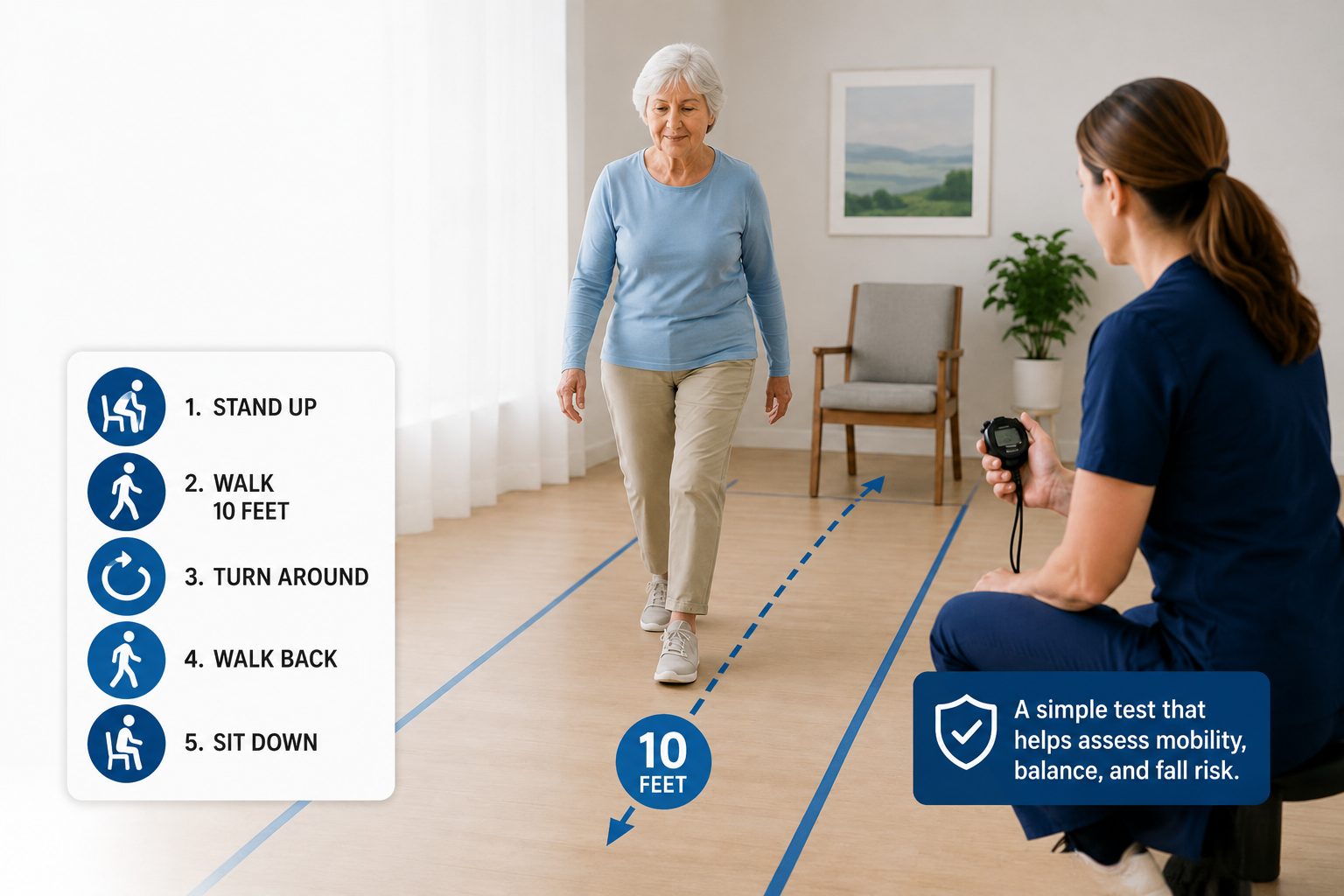
The Timed Up and Go Test for Seniors, or TUG test, is one of the most commonly used mobility and fall-risk screening tools for older adults. It measures how long it takes to stand up from a chair, walk 10 feet, turn around, walk back, and sit down.
This test looks at several important parts of movement at once. It can help tell if balance and mobility are changing and if fall risk may be increasing.
Quick Answer
The Timed Up and Go Test measures how many seconds it takes to stand from a chair, walk 10 feet, turn around, walk back, and sit down. Many older adults complete the test in about 10 to 12 seconds. A score of 12 seconds or longer may suggest increased fall risk, especially when combined with weakness, unsteadiness, or a history of falls.
The Timed Up and Go Test for Seniors is commonly used by physical therapists, physicians, and other healthcare professionals because it provides a quick snapshot of mobility, balance, and fall risk in less than a minute.
What You’ll Learn
- How to perform the Timed Up and Go test safely
- What normal TUG test scores may mean
- How to interpret slower scores without overreacting
- Common reasons older adults perform poorly
- When physical therapy may help improve balance and mobility
Safety First Before Trying the TUG Test
The Timed Up and Go test may look simple, but it includes standing up, walking, turning, and sitting down. These movements can be challenging for someone with poor balance, dizziness, weakness, recent falls, or shortness of breath.
Do not perform this test alone if you feel unsteady, have fallen recently, use a walker, feel dizzy when standing, or need help walking. Have a family member, caregiver, or healthcare professional nearby for safety.
This article is for education only and does not replace medical advice, diagnosis, or treatment.
How to Perform the Timed Up and Go Test
To perform the TUG test, you only need a chair, a stopwatch, and a measured walking distance of 10 feet.
What you need
- A standard chair with armrests if available
- A stopwatch or phone timer
- A clear 10-foot walking path
- Comfortable shoes
- Your usual cane or walker, if you normally use one
Step-by-step instructions
- Sit with your back against the chair.
- Place your feet flat on the floor.
- On the word “Go,” stand up from the chair.
- Walk forward 10 feet at your normal safe pace.
- Turn around.
- Walk back to the chair.
- Turn and sit back down.
- Stop the timer once you are fully seated.
The goal is not to rush. The goal is to move at a safe, normal walking speed.
What Is a Normal Timed Up and Go Test Score for Seniors?
A TUG score is measured in seconds. In general, a faster time suggests better functional mobility, while a slower time may suggest difficulty with strength, balance, walking, turning, or confidence.
Many healthy older adults complete the Timed Up and Go test in about 10 to 12 seconds. A score of 12 seconds or longer may suggest a higher risk of falling, especially if the person also has a history of falls, weakness, dizziness, or trouble walking.
TUG Score Interpretation Table
| TUG Time | General Meaning | What to Consider |
|---|---|---|
| 10 seconds or less | Often considered good functional mobility | Continue staying active and practicing balance safely. |
| 11–12 seconds | May still be normal for many older adults | Watch for other concerns such as recent falls, weakness, or unsteadiness. |
| 12–14 seconds | May suggest increased fall risk | Consider discussing balance and mobility with a healthcare provider. |
| More than 14 seconds | May indicate a higher risk for falls or mobility limitations | A physical therapy assessment may help identify the cause. |
| 20 seconds or more | May suggest significant mobility difficulty | Further evaluation is recommended, especially if walking outside the home is difficult. |
| 30 seconds or more | May suggest major mobility limitation | Professional support is strongly recommended for safety. |
Important: A TUG score does not diagnose a problem by itself. It is one screening tool. A person’s medical history, medications, strength, balance, vision, sensation, home setup, and fall history should also be considered.
The Timed Up and Go Test for Seniors is often used by physical therapists and other healthcare professionals as a quick screening tool to identify mobility limitations and possible fall risk.
What Your Results May Mean
If your TUG score is slower than expected, it does not automatically mean something is seriously wrong. It simply means your body may be having difficulty with one or more parts of safe movement.
- Standing up from a chair
- Starting to walk
- Walking speed
- Turning safely
- Sitting down with control
- Balance confidence
- Using a cane or walker effectively
Why the Timed Up and Go Test Matters for Seniors
The Timed Up and Go Test for Seniors matters because it looks at real-life movement. Getting out of a chair, walking across a room, turning, and sitting down are all movements older adults perform many times each day.
When these movements become slower, less steady, or less confident, the risk of falls may increase. The TUG test can help identify early changes before a serious fall occurs.
Common Reasons People Perform Poorly on the TUG Test
- Leg weakness: Difficulty standing from a chair can slow the entire test.
- Poor balance: Unsteadiness may make walking and turning slower.
- Fear of falling: Worry about falling can cause shorter steps and slower movement.
- Pain: Hip, knee, back, or foot pain can affect walking speed.
- Neurologic changes: Stroke, Parkinson’s disease, neuropathy, or other conditions can affect walking.
- Medication side effects: Some medications may cause dizziness, sleepiness, or unsteadiness.
- Vision problems: Poor vision can affect walking confidence and safety.
- Unsafe home setup: Clutter, rugs, poor lighting, or narrow spaces can increase risk.
Signs You May Benefit from Physical Therapy
You may benefit from a physical therapy assessment if you notice any of the following:
- You take 12 seconds or longer to complete the TUG test
- You have fallen in the past year
- You feel unsteady when walking or turning
- You hold onto furniture while walking through the house
- You avoid stairs, curbs, or uneven surfaces
- You have trouble getting out of chairs
- You feel weaker than you used to
- Your family is concerned about your balance or safety
A physical therapist can perform a more detailed evaluation when the Timed Up and Go Test for Seniors suggests balance, mobility, or fall-risk concerns.
How to Improve Your TUG Score
Improving your performance on the Timed Up and Go Test for Seniors often requires a combination of strength training, balance exercises, walking practice, and fall prevention strategies.
- Leg strengthening: Chair stands, heel raises, and seated strengthening may help.
- Balance training: Safe standing balance exercises can improve stability.
- Walking practice: Short, frequent walks may improve endurance and confidence.
- Turning practice: Learning to turn slowly and safely can reduce fall risk.
- Home safety changes: Removing tripping hazards can make daily movement safer.
Continue Learning
Frequently Asked Questions About the Timed Up and Go Test for Seniors
What is the Timed Up and Go Test for Seniors?
The Timed Up and Go Test is a simple mobility test that measures how long it takes to stand from a chair, walk 10 feet, turn around, walk back, and sit down.
What is a normal TUG test score for seniors?
Many older adults complete the test in about 10 to 12 seconds. A time of 12 seconds or longer may suggest increased fall risk, especially when combined with other concerns such as weakness, unsteadiness, or a history of falls.
Does a slow TUG score mean I will fall?
No. A slow TUG score does not mean you will definitely fall. It means you may have mobility or balance factors that deserve attention.
Can I use my cane or walker during the TUG test?
Yes. Use the assistive device you normally use for walking. The goal is to measure your usual safe mobility.
How often should I repeat the TUG test?
If you are using the test to track progress, it may be repeated every few weeks or after completing a balance or strengthening program. Ask your healthcare provider what is appropriate for you.
Repeating the Timed Up and Go Test for Seniors every few weeks can help track progress and determine whether strength, balance, and mobility are improving over time.
Is the TUG test enough to determine fall risk?
No. The TUG test is helpful, but it should not be the only measure used. Fall risk is best understood by looking at strength, balance, walking, medications, vision, sensation, home safety, and medical history.
Medical Review Statement
This article was written for patient education and reviewed from a physical therapy perspective. It is intended to help older adults and caregivers better understand mobility screening and fall prevention. It should not replace individualized medical advice from your physician, physical therapist, or healthcare provider.
For additional fall prevention information, visit the CDC STEADI Fall Prevention Program.
Concerned About Balance, Walking, or Fall Risk?
Continuity Healthcare provides physical therapy in the home for older adults who want to improve strength, balance, mobility, and confidence.
Our therapy services are designed for seniors, Medicare beneficiaries, and families who want support before a fall happens.
Start Therapy at HomeLast updated: June 2026. Educational content only. Always seek medical advice for dizziness, falls, new weakness, chest pain, shortness of breath, sudden balance changes, or other concerning symptoms.