
Knee Replacement Recovery: A Complete Week by Week Guide
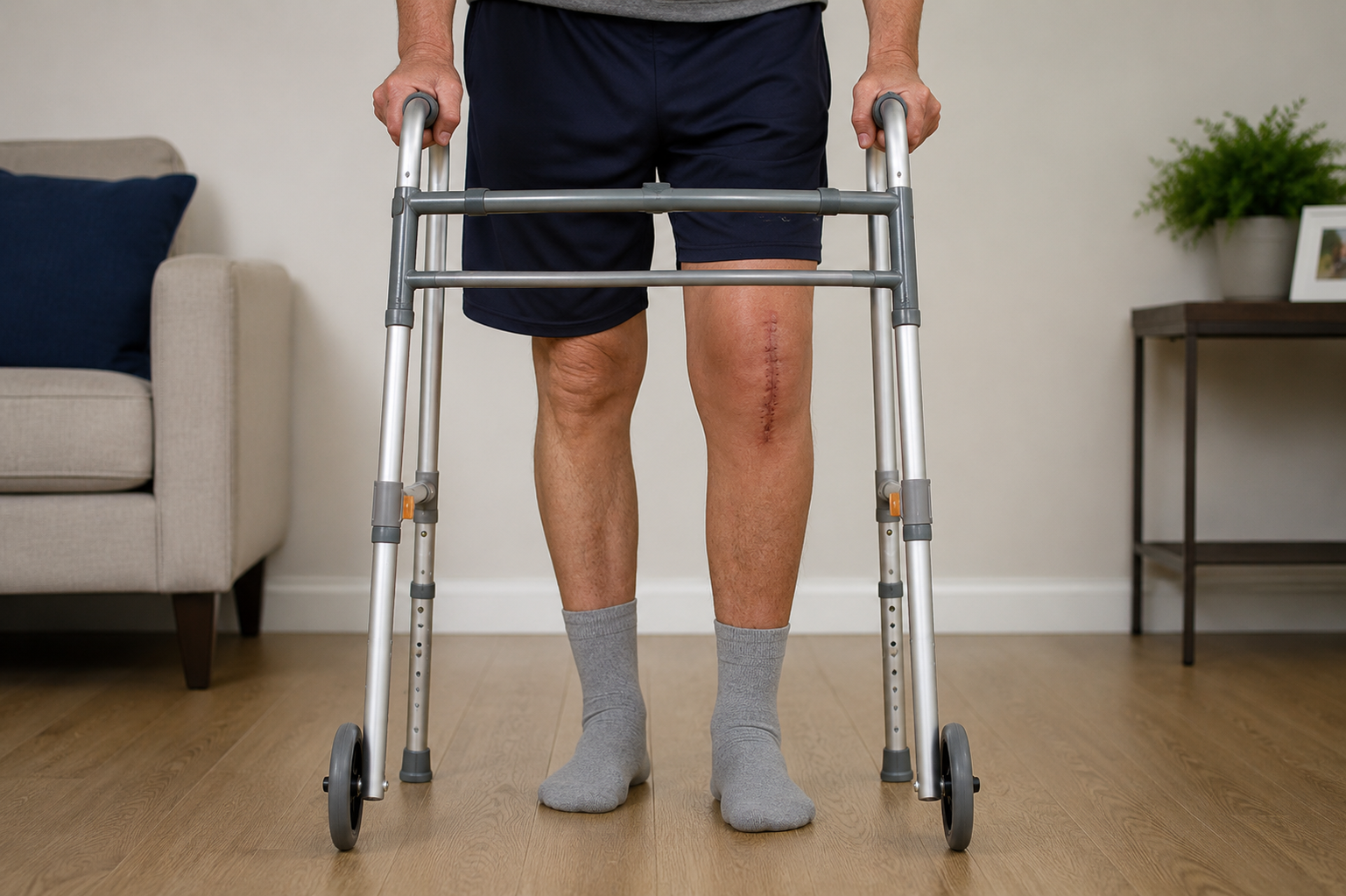
Knee replacement recovery is a gradual process that begins immediately after surgery and continues for several months. Most people use a walker early in recovery, gradually improve their range of motion and strength, and return to many daily activities within 6 to 12 weeks. While significant improvements often occur during the first three months, recovery may continue for up to a year as strength, flexibility, endurance, and confidence continue to improve. Understanding what to expect week by week can help you recover with greater confidence.
This knee replacement recovery guide explains what many patients experience during the first week, first month, and first year after surgery.
What You'll Learn About Knee Replacement Recovery
Knee Replacement Recovery Timeline
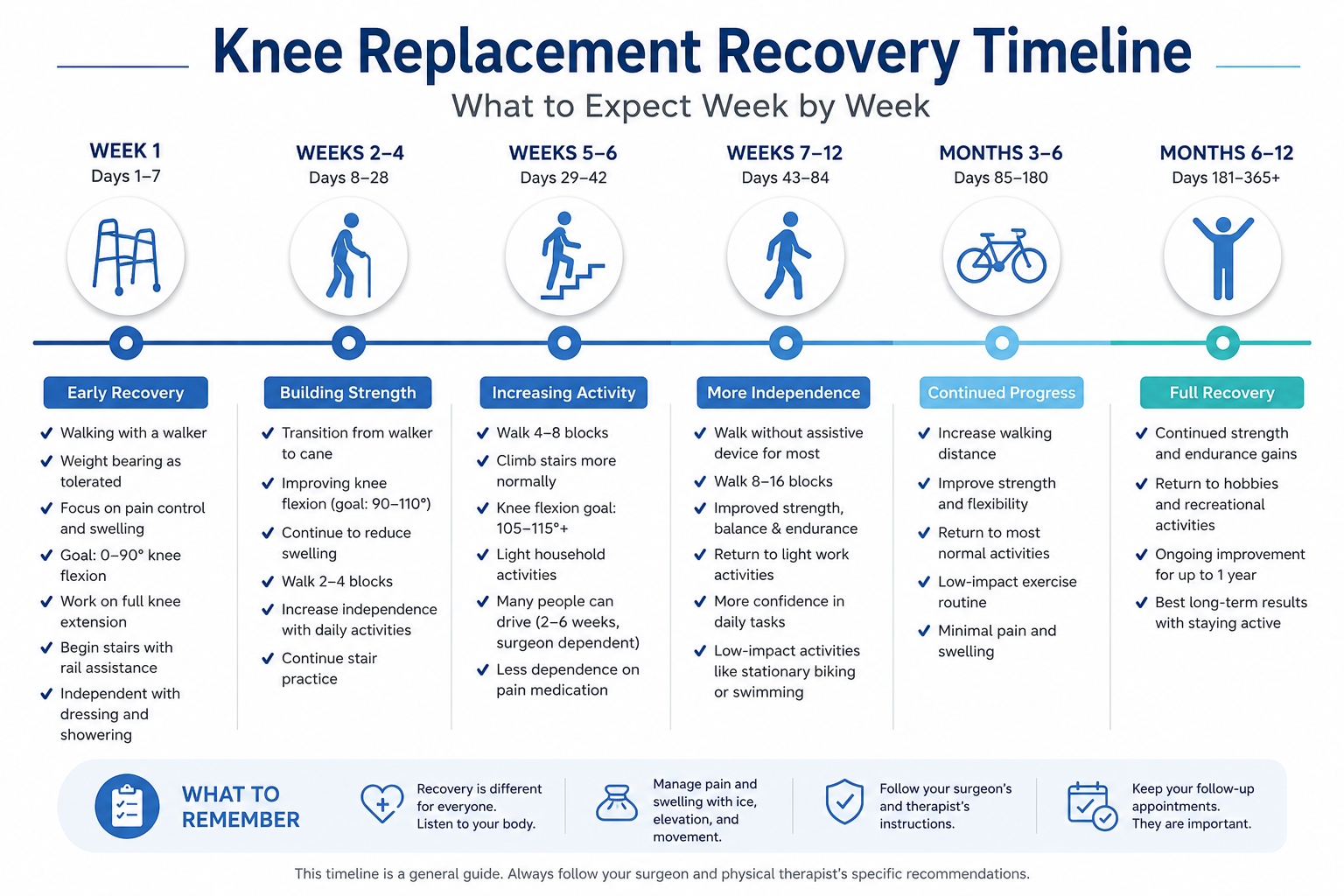
The timeline below gives a general overview of what many people experience after total knee replacement surgery. Your recovery may be faster or slower depending on your health, pain level, swelling, strength, mobility, and surgeon’s instructions.
Knee Replacement Recovery Milestones at a Glance
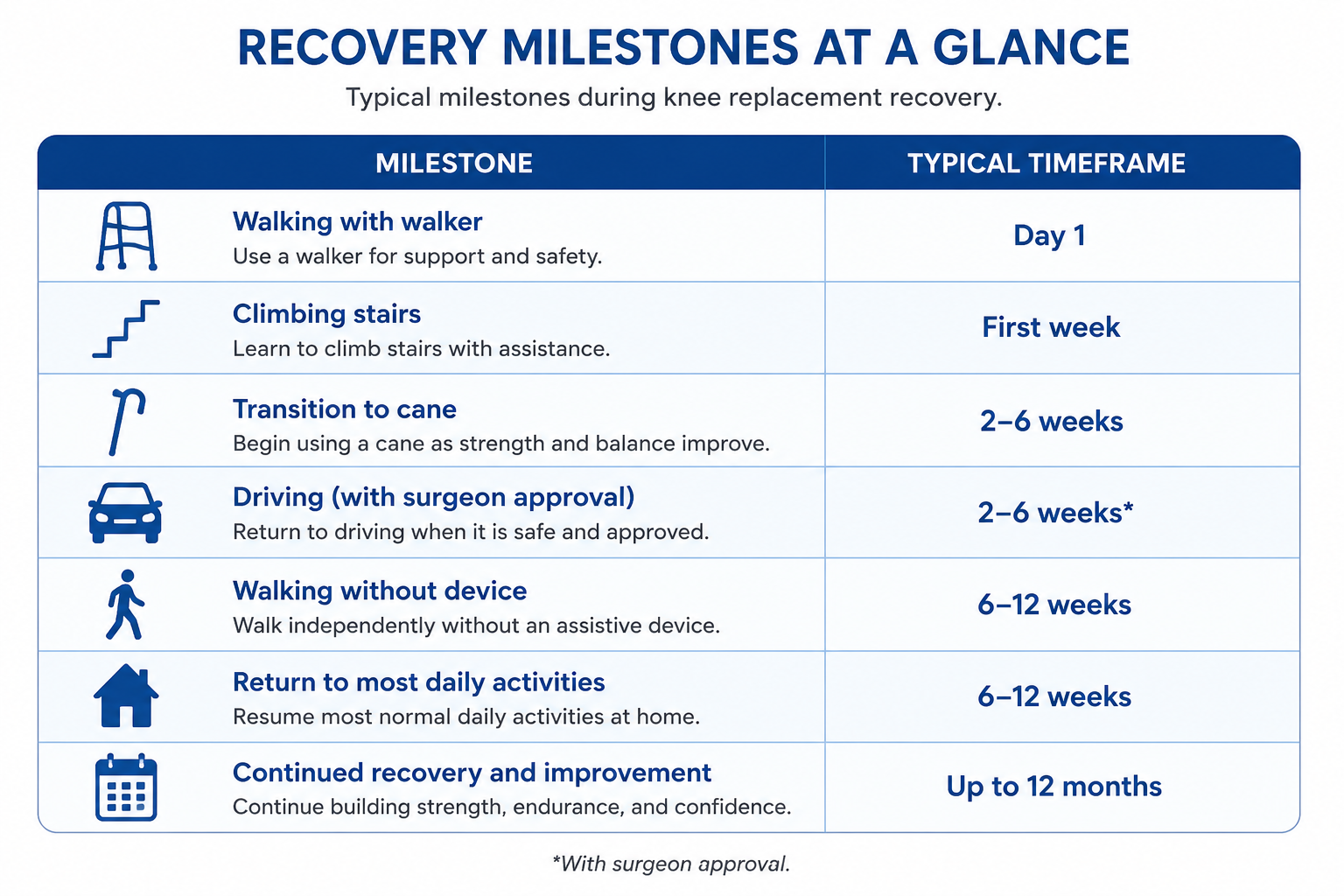
| Milestone | Typical Timeframe |
|---|---|
| Walking with a walker | Day 1 or shortly after surgery |
| Climbing stairs with assistance | First week |
| Transitioning from walker to cane | Often 2–6 weeks |
| Driving, with surgeon approval | Often 2–6 weeks |
| Walking without an assistive device | Often 6–12 weeks |
| Returning to many daily activities | Often 6–12 weeks |
| Continued recovery and improvement | Up to 12 months |
Week 1 After Knee Replacement
The first week after knee replacement focuses on healing, pain control, swelling management, and beginning safe movement. Many patients start walking with a walker shortly after surgery.
Early walking helps improve circulation, reduce stiffness, and begin rebuilding confidence. During this stage, most people are encouraged to put weight through the surgical leg as tolerated unless their surgeon gives different instructions.
Common Goals
- Walk short distances with a walker
- Manage pain and swelling
- Begin gentle knee motion
- Practice safe transfers
- Begin stairs with rail assistance when appropriate
Early Motion Goals
Many rehabilitation plans aim for about 90 degrees of knee bend during the early recovery period while also working toward full knee extension, or the ability to fully straighten the knee.
Weeks 2–4 of Knee Replacement Recovery
During weeks 2 through 4, many people notice gradual improvements in walking, knee motion, and confidence with daily activities.
This is often when patients begin walking farther, performing more household tasks, and improving their ability to bend and straighten the knee. Some people may begin transitioning from a walker to a cane, but this depends on strength, balance, pain, and walking quality.
Weeks 5–6 of Knee Replacement Recovery
By weeks 5 and 6, many people are walking longer distances, climbing stairs with more confidence, and relying less on stronger pain medication.
Some patients may be cleared to drive during this stage, depending on which knee was replaced, medication use, reaction time, strength, and surgeon approval.
Range of motion may continue improving during this phase. Many patients are working toward 105 to 110 degrees of knee bend or more, depending on their individual plan.
Weeks 7–12 of Knee Replacement Recovery
During weeks 7 through 12, many people regain more independence and return to most daily activities. Walking often becomes smoother, endurance improves, and confidence usually increases.
Some patients are able to walk without an assistive device during this stage, while others may continue using a cane for safety. Low-impact activities such as walking, stationary cycling, and swimming may be appropriate when cleared by the surgeon.
Months 3–12 After Knee Replacement
Knee replacement recovery does not end at three months. Many patients continue improving for up to a year after surgery.
During this longer recovery period, strength, flexibility, walking endurance, and confidence may continue to improve. Many people return to hobbies, community activities, and low-impact recreation with proper guidance.
How Long Does Swelling Last After Knee Replacement?
Swelling is common after knee replacement surgery and may last for several weeks or months. It often increases after activity and improves with rest, elevation, compression, and ice.
- Elevate the leg when resting
- Use ice as directed
- Wear compression garments if recommended
- Walk regularly throughout the day
- Avoid sitting too long without movement
When Can You Drive After Knee Replacement?
Driving after knee replacement depends on the surgical side, pain medication use, leg control, reaction time, and surgeon approval.
Many patients are advised not to drive until they are no longer taking narcotic pain medication and can safely control the vehicle. For some people, this may be a few weeks. For others, it may take longer.
Always ask your surgeon before returning to driving.
When Can You Stop Using a Walker?
Many people want to stop using a walker quickly, but transitioning too early can increase fall risk and create poor walking habits.
A typical progression is walker, then cane, then independent walking. The right timing depends on strength, balance, pain, swelling, and walking quality.
Your physical therapist can help determine when it is safe to move from one device to the next.
Range of Motion Goals After Knee Replacement
Knee motion is an important part of recovery. Most patients work on both bending and straightening the knee.
| Timeframe | Common Range of Motion Goal |
|---|---|
| 0–3 weeks | Work toward 0–90 degrees |
| 3–4 weeks | Progress toward about 110 degrees |
| 4–8 weeks | Continue toward full functional motion |
Your surgeon and therapist may adjust these goals based on your procedure, swelling, pain, and medical history.
When Should You Call Your Surgeon?
Contact your surgeon if you notice symptoms that may suggest infection, blood clot, or another complication.
- Fever or chills
- Increasing redness, warmth, or drainage near the incision
- Severe calf pain
- Sudden or worsening swelling
- Shortness of breath
- Chest pain
- New or worsening pain that does not improve
Helpful Knee Replacement Recovery Resource
For more information about total knee replacement, visit the American Academy of Orthopaedic Surgeons total knee replacement guide.
Frequently Asked Questions
How long does knee replacement recovery take?
Many people return to most daily activities within 6 to 12 weeks, but full knee replacement recovery may continue for up to 12 months.
How long will I need a walker after knee replacement?
Many patients use a walker for several weeks before progressing to a cane and eventually walking independently. The timeline depends on strength, balance, pain, swelling, and walking quality.
Is swelling normal after knee replacement?
Yes. Swelling is common after knee replacement surgery and may continue for several weeks or months, especially after activity.
When can I drive after knee replacement surgery?
Driving timelines vary. Many people must wait until they are off narcotic pain medication, have good leg control, and are cleared by their surgeon.
How much knee bend should I have after knee replacement?
Many recovery plans aim for about 90 degrees early in recovery and continued improvement toward 105 to 110 degrees or more over the following weeks.
Recover With More Confidence at Home
Knee replacement recovery can feel overwhelming, especially when travel to outpatient therapy is difficult.
Continuity Healthcare provides outpatient physical therapy in the comfort of your home to help older adults improve strength, mobility, balance, walking ability, and confidence after surgery.
Start Therapy at Home