
30 Second Chair Stand Test for Seniors: Measure Lower Body Strength and Independence
Also Known As:
• 30 Second Sit to Stand Test
• 30 Second Sit-to-Stand Test
• 30STS Test
• 30 Second Chair Rise Test
• Senior Chair Stand Test
• Chair Stand Test for Seniors
Although the names vary, they generally describe the same lower body strength test used by healthcare professionals to evaluate muscle performance, functional strength, and mobility in older adults.
Quick Answer: The 30 Second Chair Stand Test measures lower body strength by counting how many times you can stand up from a chair and sit back down in 30 seconds without using your arms. It is commonly used with older adults to assess muscle performance, functional strength, and mobility.
What You'll Learn
✓What the test measures
✓How to perform it safely
✓Normal scores by age and sex
✓How to improve leg strength after 65
Safety First
This article is for education only. Do not perform the test if standing from a chair is unsafe or causes dizziness, chest pain, severe shortness of breath, loss of balance, or significant pain. If you recently had surgery, experienced a fall, or have a medical concern, speak with your physician or physical therapist first.
What Is the 30 Second Chair Stand Test for Seniors (30 Second Sit to Stand Test)?
The 30 Second Chair Stand Test for Seniors is a lower body strength test for seniors. It measures how many times a person can rise from a chair and sit back down in 30 seconds. This test is also commonly called the 30 Second Sit to Stand Test, 30 Second Sit-to-Stand Test, 30STS, or 30 Second Chair Rise Test. Although the names vary, they generally refer to the same functional strength test used to assess lower body strength in older adults. Physical therapists and other healthcare professionals often use this test because standing from a chair is a real-life activity. It reflects strength needed for daily tasks such as getting up from a chair, standing from the toilet, walking, climbing stairs, and maintaining independence.Why This Test Matters
Lower body strength is important for safe movement and daily independence. When leg strength declines, common activities can become harder, including walking, transferring, climbing stairs, and recovering from a stumble. The 30 Second Chair Stand Test for Seniors helps screen muscle performance and provides valuable information about lower body strength and everyday function. A lower score may suggest weakness, reduced endurance, decreased activity level, or a need for a more complete mobility assessment.
What is muscle performance?
Muscle performance describes how well muscles produce force and perform work. It includes strength, power, and endurance. The 30 Second Chair Stand Test primarily reflects lower body strength and muscular endurance.
Equipment Needed
You Need
A standard chair, a stopwatch or phone timer, and a safe open area.Best Chair Setup
Use a firm chair about 17 inches high. Avoid soft couches, recliners, rolling chairs, or chairs that slide easily.How to Perform the 30 Second Chair Stand Test for Seniors
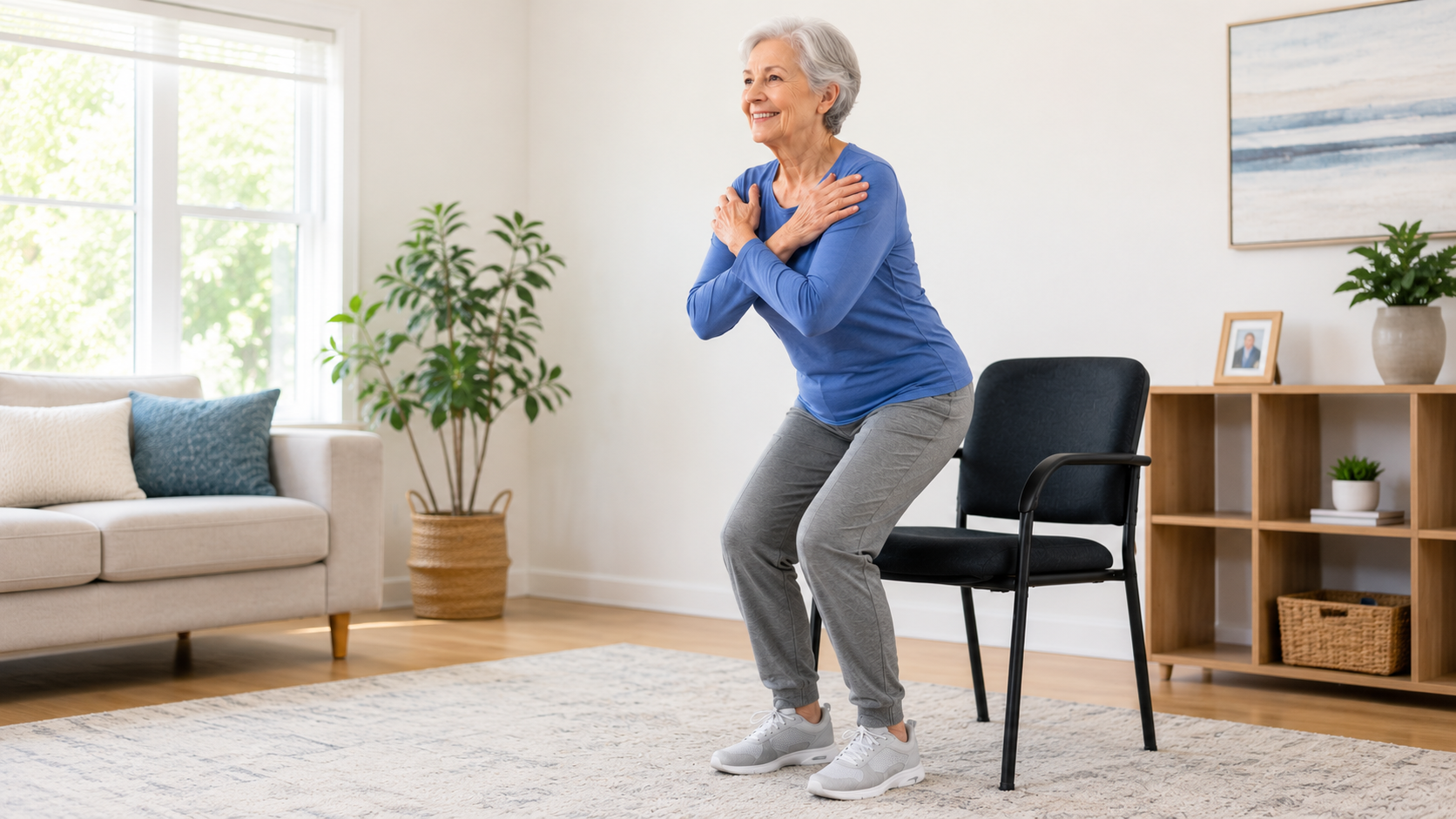
Sit in the middle of a firm chair with both feet flat on the floor.
Cross your arms over your chest. Do not push off from the chair unless instructed for safety.
When the timer starts, stand up fully and then sit back down under control.
Repeat as many full stands as possible in 30 seconds.
Count each complete stand. If you are more than halfway up when time ends, count that repetition.
30 Second Chair Stand Test for Seniors: Normal Scores by Age and Sex
The following ranges are commonly used as general reference values for community-dwelling older adults. Scores should not be treated as a strict pass-or-fail result.| Age | Men | Women |
|---|---|---|
| 60–64 | 14–19 | 12–17 |
| 65–69 | 12–18 | 11–16 |
| 70–74 | 12–17 | 10–15 |
| 75–79 | 11–17 | 10–15 |
| 80–84 | 10–15 | 9–14 |
| 85–89 | 8–14 | 8–13 |
| 90–94 | 7–12 | 4–11 |
30 Second Chair Stand Test Score Interpretation
| Score | Possible Meaning |
|---|---|
| Above age norms | May suggest stronger-than-average lower body strength. |
| Within age norms | Generally consistent with expected strength for age and sex. |
| Slightly below age norms | May suggest mild strength deficits or reduced activity level. |
| Well below age norms | May indicate weakness affecting daily function, transfers, walking, or stair climbing. |
| Less than 8 repetitions | May suggest increased risk for loss of physical independence and may warrant further assessment. |
What Your Results May Mean
A lower score does not automatically mean something is wrong. However, it may show that your legs are not generating enough strength or endurance for everyday activities. A physical therapist may compare your chair stand score with other tests, such as walking speed, balance testing, the Timed Up and Go Test, or the One Leg Stand Test. Together, these tests provide a clearer picture of strength, mobility, balance, and fall risk.Common Reasons People Score Below Average
Physical Factors
Leg weakness, knee or hip pain, poor balance, arthritis, reduced endurance, or recent illness can lower your score.Lifestyle Factors
Reduced activity, fear of falling, long periods of sitting, and decreased confidence with movement can also affect performance.How to Improve Leg Strength After 65
Many older adults can improve their 30 Second Chair Stand Test score with consistent strengthening and mobility exercises. The goal is not just to increase the number of repetitions, but to make daily activities easier and safer.
Helpful exercises may include:
For a guided starting point, see our article on 16 Chair Exercises for Seniors.
-
- Sit-to-stand practice
-
- Chair squats
-
- Heel raises
-
- Marching in place
-
- Step-ups when safe
-
- Walking programs
-
- Balance exercises
When to Consider Physical Therapy
Consider a physical therapy evaluation if you have difficulty standing from a chair, feel unsteady while walking, avoid stairs, have fallen recently, or score below the expected range for your age. Physical therapy can help identify the cause of weakness and build a plan to improve strength, mobility, balance, and confidence at home. If your score on the 30 Second Chair Stand Test for Seniors is below expected levels, a physical therapist can help identify contributing factors and create a personalized plan to improve strength and mobility.Frequently Asked Questions
What does the 30 Second Chair Stand Test measure for Seniors?
It measures lower body strength and muscular endurance by counting how many times you can stand from a chair in 30 seconds.Is the 30 Second Chair Stand Test the same as the 30 Second Sit to Stand Test?
Yes. The test is commonly called the 30 Second Chair Stand Test, 30 Second Sit to Stand Test, 30 Second Sit-to-Stand Test, 30STS, or Chair Rise Test.What is a good 30 Second Chair Stand Test score?
A good score usually falls within or above the normal range for your age and sex. Scores vary based on strength, activity level, health conditions, and mobility.Can I use my arms during the test?
The standard test is performed with arms crossed over the chest. If you need your arms for safety, do not force the standard version without professional guidance.Does this test measure balance or strength?
The test primarily measures lower body strength and muscular endurance, but balance, pain, confidence, and mobility can also affect performance.How often should I repeat the test?
Many people repeat the test every few weeks to monitor progress. Use the same chair and setup each time for more consistent results.What if I score below average?
A below-average score may suggest an opportunity to improve strength, mobility, and confidence. If you also have falls, pain, or difficulty walking, a physical therapy evaluation may be helpful.How can I improve my score?
Consistent lower body strengthening, sit-to-stand practice, walking, and balance exercises may help improve your score over time.Need Help Improving Strength, Balance, or Mobility?
Continuity Healthcare provides outpatient physical therapy in the comfort of your home for older adults who want to improve strength, mobility, balance, and independence. Start Therapy at HomeContinue Learning
One Leg Stand Test for Seniors
Learn how a simple 10-second balance test may reveal changes in stability.
Timed Up and Go Test for Seniors
Understand what your TUG score may mean for mobility and fall risk.
7 Balance Exercises for Seniors
Practice simple balance exercises to improve stability and confidence.
16 Chair Exercises for Seniors
Improve strength and mobility with senior-friendly chair exercises.
Home Hazards That Increase Fall Risk
Learn how to make the home safer and reduce common fall hazards.
Patient Education Hub
Explore more senior health, mobility, strength, and fall prevention resources.
Medical Review Statement: This article was created for patient education by Continuity Healthcare and reviewed for clinical accuracy using rehabilitation and older adult functional testing principles. It is not a substitute for individualized medical advice, diagnosis, or treatment.